
This guide will show you how to prepare and import your Meshy-generated 3D models into popular game engines like Unity and Unreal Engine.
Step 1: Download the Plugin
You can find this on Resources:
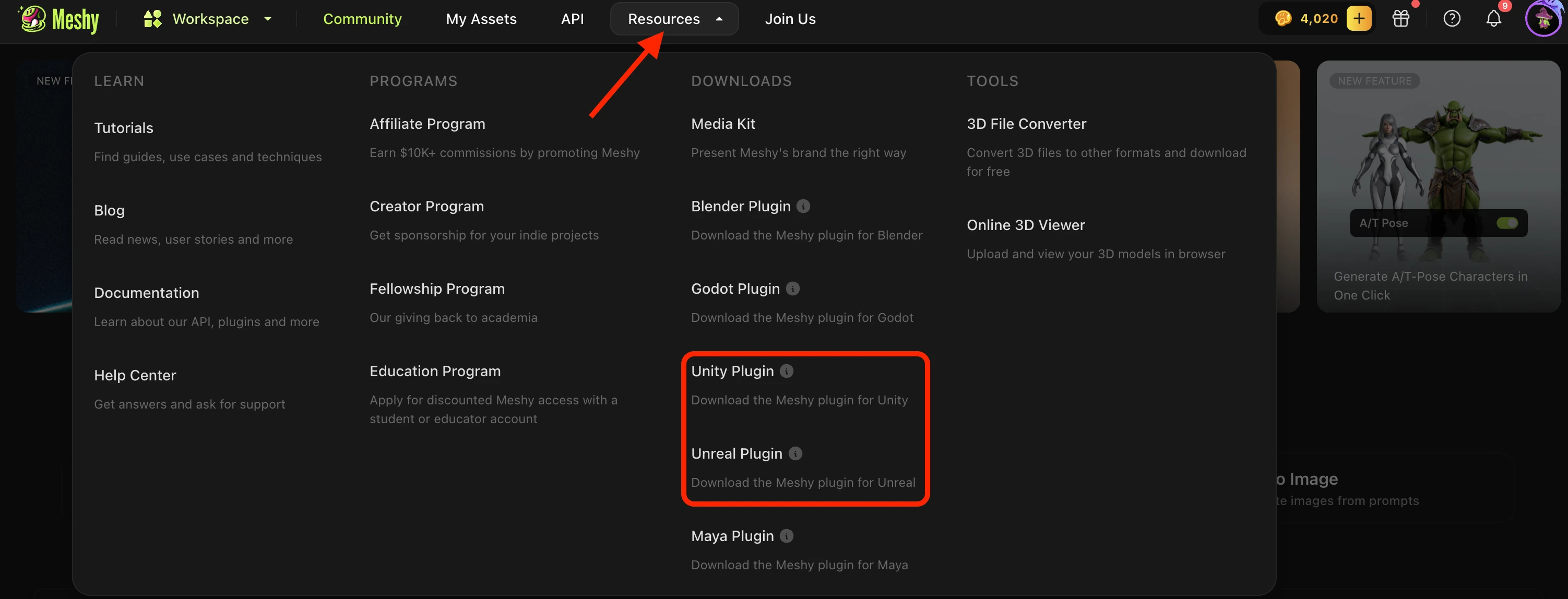
Step 2: Exporting Your Model
Just like with Blender, the key is to choose the correct file format. The recommended format is .GLB, as it's widely supported and includes all necessary textures.
Go to your completed model in Meshy.
Click the Download button and choose .GLB.
Select your desired resolution and click Export.
Step 3: Importing into Unity
Open your Unity project.
Drag and drop the
.glbfile directly into your Project window (the folder pane at the bottom).Unity will automatically import the model, its materials, and textures. You will see a new prefab asset created in your project.
Drag the new prefab from the Project window into your scene to add your model to the game world.
Step 4: Importing into Unreal Engine
Open your Unreal Engine project.
Go to the Content Browser and click Import.
Select the
.glbfile you downloaded. Unreal Engine will automatically detect it as a glTF file and prompt you with import options.For most cases, the default settings are fine. Click Import All to bring the model, textures, and materials into your project.
Drag the new asset from the Content Browser into your scene to place your model.
Importing into Roblox
To use a Meshy model in Roblox, export it as FBX (recommended for rigged/animated models) or OBJ (for static props).
Static models (OBJ or FBX)
In Meshy, download your model in FBX or OBJ format.
Open Roblox Studio.
In the menu bar, go to Home > Import 3D (or Avatar > 3D Importer for character models).
Select your downloaded file and click Open.
Review the import preview and settings, then click Import.
The model will appear in your workspace. You can then position, scale, and configure it as needed.
Animated / rigged characters (FBX)
In Meshy, rig and animate your character, then download as FBX.
In Roblox Studio, go to Avatar > 3D Importer.
Select the FBX file. Make sure the Rig Type matches your character (R15 for humanoids).
Click Import. The rigged model will be added to your workspace and can be used with Roblox's animation system.